
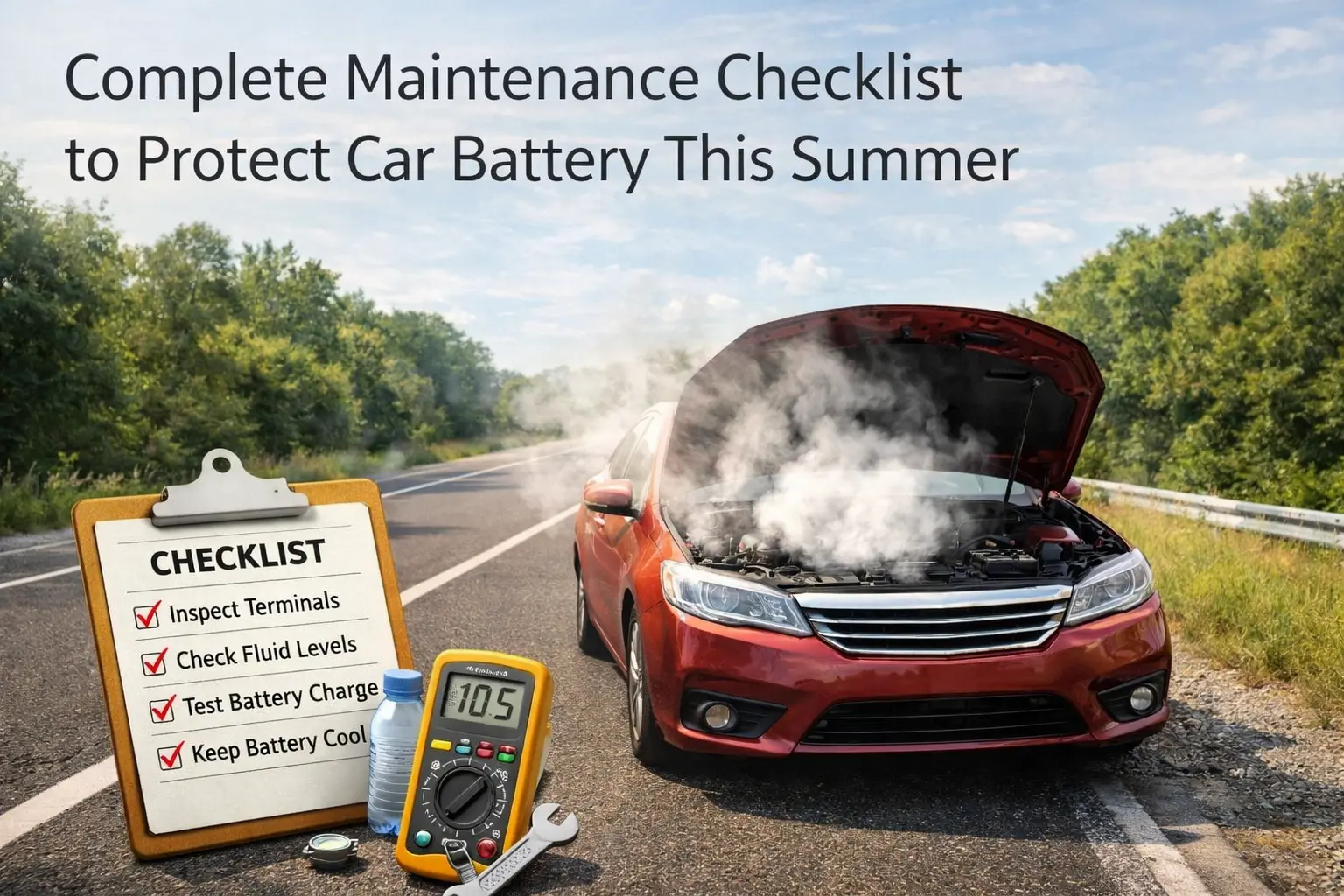
Summer is the season most Melbourne car owners associate with long drives, road trips, and days out across Victoria. It is also the season that ends more car batteries than any other time of year. High ambient temperatures, heavy car air conditioning use, and vehicles sitting in direct sun create conditions that wear a battery down faster than anything else in the Australian climate.
A car battery that is borderline in November rarely survives through February without failure. BCS Workshop provides car battery testing near you and sees the same avoidable failures every summer across Melbourne. Our team is located at 752A Springvale Road, Mulgrave, and is available on (03) 9501 0011.
Most battery failures are predictable, and a straightforward car battery maintenance checklist completed before the heat peaks can identify a battery about to fail before it leaves you stranded.
This checklist covers every key area of car battery maintenance for Melbourne car owners heading into the warmer months.
Why Summer Is the Hardest Season on a Car Battery in Melbourne
Most Melbourne car owners do not think twice about their battery during summer. The car starts every morning, so the battery must be fine. The problem is that summer heat works on a battery quietly and over time, not all at once.
Heat causes the fluid inside the battery to evaporate slowly. It degrades the internal plates. It reduces the battery's ability to hold and deliver a charge. But because warm weather also makes engines easier to start, the car keeps going right through summer without any sign that something is wrong. The damage is there. It just has not had a chance to show itself yet.
That moment usually comes in April or May, on the first genuinely cold morning of autumn, when the engine needs real cranking power, and the battery simply does not have it left to give.
Most car batteries in Melbourne last somewhere between three and five years. If yours is getting close to that mark and has never been load tested, autumn is the time to find out where it actually stands, not after it leaves you stranded.
Any car battery older than four years should be treated as a priority item on this checklist, regardless of whether any symptoms are present.
Complete Car Battery Maintenance Checklist for Summer
The following checklist gives you everything you need to check now before the season change:
1. Check the Car Battery Age
The single most important step in any summer car battery maintenance checklist is knowing how old the battery actually is. A car battery approaching or past four years in Melbourne conditions should be load tested before summer, not after the first breakdown.
What to check:
-
Locate the manufacturer's date sticker on the top or side of the car battery casing
-
If no sticker is visible, check your last service receipt or ask a mechanic to look it up during your next visit
-
Any car battery over four years old requires a load test, regardless of whether the car is starting reliably
A visual inspection alone is not enough. BCS Workshop includes car battery load testing as part of a major car service in Melbourne, which assesses both battery condition and charging system performance together.
2. Inspect the Battery Terminals for Corrosion
Corroded terminals are one of the most common causes of unreliable starting and car electrical problems during Melbourne's summer. Corrosion appears as white, blue, or grey powdery buildup around the terminal connections and increases electrical resistance, reducing the power the car battery can deliver to the starter motor.
What to check:
-
Inspect both terminals for any powdery or crystalline buildup
-
Check whether the terminal clamps can be moved by hand, which indicates a loose connection
-
Look for cracks or swelling in the car battery casing, both of which signal heat damage
Mild corrosion can be cleaned carefully at home. Severe corrosion, loose terminals, or any casing deformation mean the car battery needs a proper assessment before summer peaks. BCS Workshop also handles broader car repair in Melbourne if corrosion has affected surrounding electrical components.
3. Test the Car Battery Voltage and Charge State
A visual inspection tells you very little about actual car battery condition. A car battery voltage check gives a clearer picture of where the battery sits in its service life before the heat of summer reveals the problem the hard way.
What the voltage readings mean:
|
Voltage Reading |
Car Battery State |
|
12.6V or above |
Fully charged and healthy |
|
12.4V to 12.6V |
Adequately charged, monitor through summer |
|
12.2V to 12.4V |
Partially discharged, investigate charging system |
|
Below 12.2V |
Low charge, load test required immediately |
|
Below 12.0V |
Critical, car battery replacement likely needed |
A basic multimeter gives a static reading but does not reveal how the battery performs under load. Car owners in Glen Waverley, Clayton, and Oakleigh who want a reliable picture of their battery's actual summer capacity should have a proper load test carried out. The car service Melbourne team at BCS Workshop carries out load testing as part of every scheduled service.
4. Check the Alternator Is Charging Correctly
A healthy car battery will still go flat if the alternator is not doing its job. The alternator is what recharges the battery while you drive, and if it is not working properly, the battery loses a little charge on every trip until one morning it simply will not start.
Signs the alternator may not be charging correctly:
-
Headlights appear dimmer than usual, particularly at idle
-
The car battery warning light is on the dashboard
-
Electrical accessories, including the air conditioning or windows, are operating sluggishly
-
The car battery is going flat repeatedly, even after a full charge
If a car battery has gone flat more than once in the same summer, the alternator should be tested before the battery is simply replaced again. For diesel ute owners across Melbourne, the blog post on the 10 most common diesel car problems and how to fix them covers related electrical and charging issues common in diesel-powered vehicles during summer.
5. Assess How the Car Is Being Used Over Summer
Battery drain in hot weather is not always caused by age alone. The way a vehicle is used during warmer months directly affects how quickly a battery deteriorates.
Usage patterns that accelerate battery drain:
-
Every time you start the car, the battery takes a hit. A quick trip to the shops and back is not long enough for the alternator to put that charge back in full.
-
Vehicles parked in direct sun for extended periods experience accelerated internal breakdown even while switched off
-
High electrical loads from car air conditioning, dashcams, phone charging, and seat coolers all draw from the battery
-
Vehicles sitting unused for more than two weeks lose charge through natural self-discharge, which is faster in heat
Car owners in Dandenong and Springvale who use a vehicle primarily for short daily errands through summer are particularly exposed to this pattern. For commercial vehicle operators, the commercial vehicle services at BCS Workshop include battery and electrical checks as part of a structured fleet maintenance schedule.
6. Inspect the Car Battery Hold-Down and Physical Security
A car battery that rattles around in its tray every time you hit a bump is wearing itself out faster than it should. It is a simple thing to check and an easy fix, but it is one most car owners never think about.
What to check:
-
Give the car battery a gentle push. If it moves, the hold-down bracket needs tightening
-
Check the tray underneath for any rust or cracks that might be affecting how securely it sits
-
Have a look at the cables and leads for any signs of fraying or heat damage near the connection points
A loose car battery is a straightforward fix during any visit. If the engine system is also due for attention before summer, the engine service covers what a full engine and electrical assessment includes at BCS Workshop.
7. Check for Parasitic Drain
A parasitic drain is an electrical draw that continues pulling power from the car battery when the car is switched off. Small standby draws from the alarm system and ECU memory are normal. An excessive parasitic drain, however, can flatten a healthy car battery overnight without any other warning sign.
Signs of a parasitic drain:
-
The car battery is flat in the morning, after the car was fully operational the previous evening
-
The car battery goes flat after two or three days of the vehicle sitting unused
-
No obvious cause, such as a door light left on or a boot not fully closed
Identifying a parasitic drain requires specialist diagnostic equipment. If you have noticed your air conditioning or other electronics behaving unusually alongside battery drain, the how to identify common car air conditioning problems early, as we have covered the electrical warning signs that often appear alongside battery and charging issues.
Signs Your Car Battery Is Dying: What to Watch For
Beyond the checklist steps above, these specific warning signs indicate a car battery approaching failure before summer peaks:
Slow or laboured engine cranking: If the engine turns over more slowly than usual on startup, particularly on warm mornings, the car battery is struggling to deliver its rated cranking amps.
The car battery warning light is on: This light indicates either that the battery is not being adequately charged or that there is a fault in the charging circuit that needs investigation.
Clicking sound when turning the key: A rapid clicking sound on startup without the engine turning over is a classic sign of insufficient car battery voltage reaching the starter motor. If your car is making any unusual sounds beyond the clicking, car noises that require attention is a worth reading before they become a larger repair.
Electrical accessories behaving erratically: Windows moving slowly, the radio resetting, or interior lights dimming on startup all indicate the car battery is no longer maintaining adequate voltage under electrical load.
Swollen or bloated car battery casing: Heat-induced swelling signals internal gas buildup and means the battery is at risk of leaking. A swollen car battery should be replaced immediately rather than monitored.
The battery is over four years old: In Melbourne's climate, a car battery over four years old that has never been load tested should be treated as a potential replacement candidate regardless of whether symptoms are present.
If any of these signs apply to your vehicle, the why your clutch fails and how to keep it in check blog is also worth reading alongside this one, as drivetrain stress caused by a weak battery and poor starter engagement can accelerate wear in related mechanical systems over time.
Summer Battery Maintenance Checklist: Quick Reference
Here are the quick checks every Melbourne car owner:
|
Checklist Item |
What to Do |
Priority |
|
Check battery age |
Locate the manufacture date and flag if over 4 years old |
High |
|
Inspect terminals |
Look for corrosion, loose clamps, or casing damage |
High |
|
Test battery voltage |
Use a multimeter or book a load test at a service centre |
High |
|
Check alternator output |
Look for dimming lights, a charging warning light, or repeat flat battery |
High |
|
Review usage patterns |
Assess short-trip frequency and extended periods of non-use |
Medium |
|
Check hold-down security |
Confirm the battery is firmly mounted with no movement |
Medium |
|
Check for parasitic drain |
Investigate if the battery goes flat when the car sits unused |
Medium |
When to Include Battery Testing in Your Car Service
Battery testing should not be a standalone task done only after something goes wrong. The most practical approach is to include it as part of every scheduled service.
A minor car service in Melbourne at BCS Workshop includes a battery condition check as standard. For car owners whose vehicles are due for a log book service in Melbourne before summer, combining the service with a full battery and alternator assessment is the most cost-effective way to head into the warmer months prepared.
BCS Workshop services all major passenger and commercial vehicle brands across Melbourne, from European models like Audi, BMW, and Volkswagen through to Japanese makes including Mazda, Toyota, and Subaru.
Conclusion
A dead car battery in a car park or on the side of the freeway is never convenient and never cheap. A quick check before summer costs a fraction of the time and money a breakdown will. The checklist above covers everything worth looking at before Melbourne's heat peaks.
We handle car battery testing, replacement, alternator checks, and full vehicle servicing for car owners across Melbourne's south-eastern suburbs. Whether you need a standalone battery test, a routine service, or a full car service in Melbourne that covers your whole vehicle, our team at BCS Workshop is the local choice Melbourne car owners return to.
Contact BCS Workshop today!


 Digiwhiz